
1.Apple’s Greater China revenue falls 13%, facing Huawei’s challenge
On February 2nd, Apple’s FY2024 Q1 earnings revealed that Greater China generated $20.8 billion (approximately CNY 149.344 billion) for the quarter, a 13% year-on-year decrease from $23.9 billion in the same period last year. On the earnings call, Apple CEO Tim Cook attributed the decline not to waning iPhone popularity but to broader economic challenges.
Cook emphasized that the 13% year-on-year downturn in Greater China revenue, alongside a robust U.S. dollar, would have a moderate impact on the company’s overall performance. Apple’s iPhone business, he noted, performed strongly in China during the fourth quarter of 2023, capturing four of the top six positions in smartphone sales.
On February 4th, market research firm Counterpoint Research reported Huawei’s resurgence in the Chinese market, reclaiming the top spot in smartphone sales for the first two weeks of 2024. The result marks Huawei’s return to the pinnacle after a decline in market share since the imposition of U.S. sanctions in 2019. Counterpoint attributed Huawei’s success to the Mate 60 series, powered by its in-house Kirin 9000S chip.
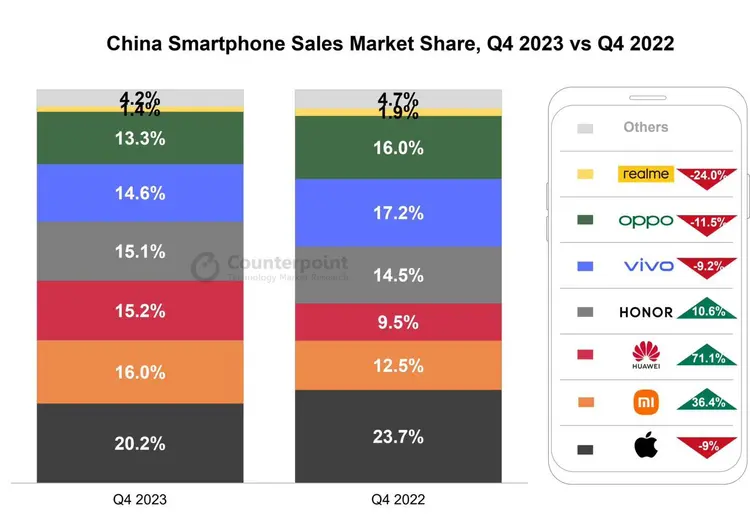
In the fiercely competitive landscape of Greater China’s mobile phone market, Apple and Huawei are poised to engage in intense competition throughout 2024 as they vie to regain the coveted top position.
2.Ma Huateng foresees full development of WeChat video account’s live e-Commerce by 2024
On January 29th, Ma Huateng, Chairman of the Board of Directors and Chief Executive Officer, expressed his satisfaction with the development of the video account and announced Tencent’s plans to fully enhance the video account’s live e-commerce capabilities this year

During an internal address, Ma Huateng underscored the critical role of the video account in the company’s trajectory. Since then, the video account has emerged as a pivotal focus for Tencent and the broader short video live streaming industry. It is anticipated that in 2024, WeChat video accounts will usher many into prosperity.
The WeChat ecosystem has emerged as a formidable force in the private sector, fostering a fiercely competitive landscape for businesses. With a staggering user base of 1.3 billion, it presents substantial growth opportunities. Initially, micro-entrepreneurs found success in advertising through WeChat ‘Moments’. Subsequently, social e-commerce ventures, community group-buying enterprises, and individuals thrived within their respective communities. Early self-media IPs achieved success through public accounts. Short videos and content creation have also gained traction, benefiting numerous self-media IPs.
Tencent has now placed the video number in the C position, marking a new milestone in Tencent’s traffic empire. By leveraging the WeChat ecosystem, Tencent has seamlessly integrated the video account with platforms such as public accounts, enterprise WeChat, mini-programs, Moments, and community forums. This holistic approach has solidified the video account’s standing as a frontrunner.
Whether in advertising or e-commerce, the video account has long been on a journey of exploration. Now, ‘quality enhancement’ emerges as the focal point of attention.
3.Korean Media Analysis: South Korea most vulnerable to US ‘Blockade’ of China
On January 30th, reports from Korean media shed light on the shifting landscape of semiconductor trade dynamics between China, South Korea, and Japan. The data reveals a noteworthy decline in China’s semiconductor imports from South Korea, dropping from $82.4 billion in 2018 to $66.2 billion in 2023, marking a significant decrease of 19.63%. Concurrently, China’s semiconductor imports from Japan witnessed an increase from $15.8 billion to $20.8 billion, representing a notable uptick of 31.2%

Korean media analysis suggests that this phenomenon stems from the susceptibility of the South Korean semiconductor industry to U.S. export regulations. In contrast, the Japanese semiconductor industry has expanded its sales channels to niche markets not covered by such regulations and has leveraged technological advancements to solidify its position as an indispensable player in the sector.
For example, China’s augmented semiconductor imports from Japan can be attributed to the country’s rising demand for automotive semiconductors—a specialized market segment unaffected by U.S. export restrictions. Renesas Electronics, a leading Japanese automotive semiconductor manufacturer, has announced plans to reopen a previously shuttered plant, effectively doubling its supply to meet escalating demand.
Meanwhile, stringent U.S. export controls have adversely impacted South Korean semiconductor giants such as Samsung Electronics and SK Hynix, resulting in a notable downturn in exports to China. Industry insiders report that the South Korean semiconductor sector faces significant challenges amidst a combination of U.S. regulatory constraints and economic downturn.
Korean media experts caution that as China’s self-sufficiency in semiconductor production grows, South Korea’s semiconductor industry could face intensified competition between the United States and China, exerting prolonged pressure on the sector in the foreseeable future.
4.The Hurun 2023 China’s top 100 food industry list has been released, with Moutai retaining its position as number one
On January 29, the Hurun Research Institute, in collaboration with Global Premiere, unveiled the ‘2023 Global Premiere—Hurun China Food Industry Top 100 List’. The roster showcases the top-performing entities in China’s vibrant food sector, reflecting the nation’s culinary landscape and economic dynamics.
Topping the list are esteemed brands including Guizhou Moutai, Wuliangye, Nongfu Spring, Luzhou Laojiao, Shanxi Fenjiu, Haitian Flavoring & Food, Jiangsu Yanghe Brewery Joint-Stock Co., Ltd., Muyuan Foods Co., Ltd., Budweiser Brewing Company APAC Limited, and Jinlongyu
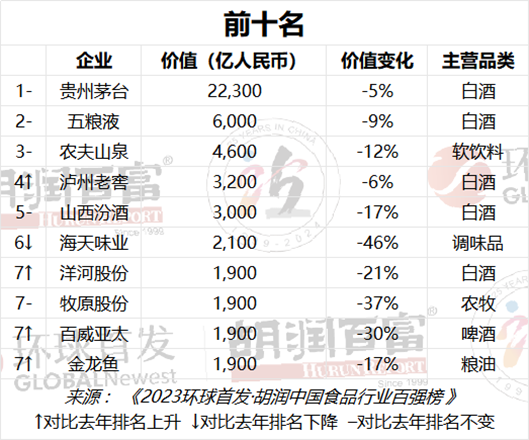
Top Ten Companies in value: 1st, 2nd, 4th, 5th are Bai Jiu Compannies
Moreover, the four of top five companies are Bai Jiu companies. In a country boasting a population of 1.4 billion, the prominence of high-grade liquor as the most valuable commodity in the food sector is remarkable and unparalleled globally, marking a distinctive facet of Chinese consumer preferences and market dynamics.
Hurun noted that this year’s list includes four new agribusinesses, marking the largest increase in this sector compared to last year’s list.
“Why do agribusinesses perform well during market fluctuations?” Hurun answered the question by stating that agricultural products are basic necessities for humans, and their demand is relatively stable. Additionally, the growth cycle of crops and livestock is usually long, making it easier for related companies to forecast and plan production. Finally, China provides a certain degree of government support and protection for agriculture.
Despite the overall decline in total value across most categories, notably agriculture and animal husbandry, ‘health food’ and ‘health alcohol’ experienced an upward trajectory.
As Moutai stands at the helm of the industry, the question lingers: How long will it maintain its leading position?
5.Henan’s Massive Man-Made Diamond Production Capacity Pressures Raw Diamond Prices
Since 2023, international raw diamond prices have experienced a persistent decline, largely attributed to subdued demand and various market dynamics. As of January 27, the Global Rough Diamond Price Index recorded a significant 18.5% decrease over the past 52 weeks, hitting a 52-week low on that date.
In response to these market conditions, the renowned international diamond conglomerate, De Beers Group, has implemented substantial price reductions across a range of rough diamonds. Notably, diamonds above 2 carats witnessed a reduction exceeding 15%, while the average prices for diamonds ranging from 0.75 carats to 2 carats saw a decline of 10-15%. Additionally, diamonds below 0.75 carats experienced a 5-10% reduction, contributing to an overall combined price reduction of about 10%. This marks a significant departure from De Beers’ pricing strategy in recent years and underscores the urgency to stimulate consumption
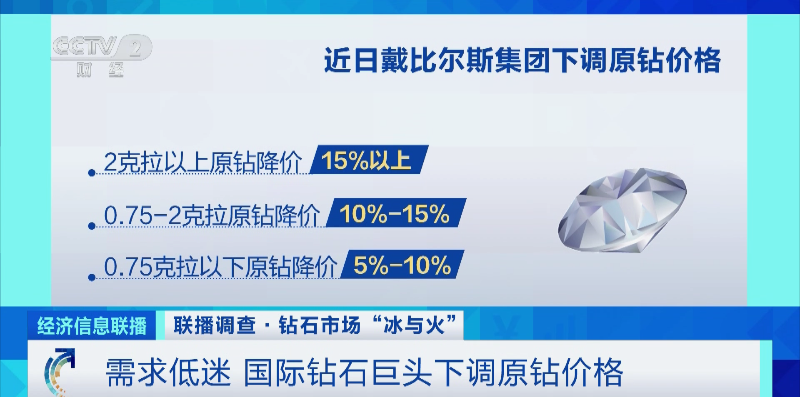
De Beer Price Cut Strategy: -15%(above 2 carats),-10%-15%(0.75 carats-2 carats), -5%-10%(below 0.75 carats)
The prevailing low demand for natural diamonds in the market stems primarily from elevated inflation rates in numerous European and American countries, dwindling consumer confidence, and the emergence of competitively priced lab-grown diamonds vying for market share.
Simultaneously, China’s synthetic diamond production, particularly from Henan province, has emerged as a formidable force, significantly impacting the market dominance traditionally held by European and American diamond giants. Current data indicates that China’s production of diamond monocrystals commands over 90% of the global output, with Henan province alone contributing 80% to this figure. Moreover, China’s capacity for producing jewelry-grade synthetic diamonds constitutes approximately 50% of the world’s total, with 80% of this production concentrated in Henan, notably in Zhecheng County, Shangqiu City.
Henan’s synthetic diamond output totals around 12 billion carats annually, with over 6 million carats of raw diamonds cultivated. A substantial portion of these diamonds are exported to India and other global hubs for cutting and processing before being distributed to regions such as Europe and North America.
The ascendancy of Henan-made synthetic diamonds underscores a transformative shift in the global diamond market landscape, presenting both challenges and opportunities for established industry players in Europe, the United States, and beyond.